


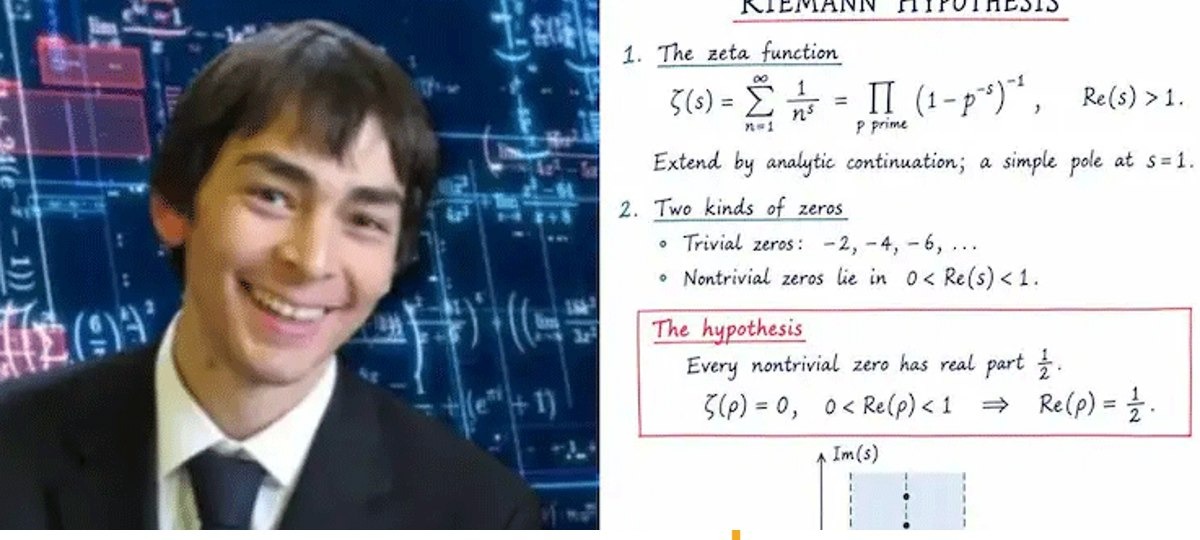

Numbers that are divisible only by 1 and the number itself are called prime numbers — such as 2, 3, 5, 7, 11, etc. Moving forward along the number line, the positions of these prime numbers appear at first glance to be irregular or random; however, mathematicians believe that a deep mathematical arrangement or pattern underlies this distribution of prime numbers. The Riemann Hypothesis essentially proposes a way to understand and predict that mathematical pattern with extreme precision; if it is proven, mathematicians will be able to clearly understand exactly how regularly or irregularly the prime numbers are distributed, and numerous mathematical results that stand on the basis of this hypothesis will become more firmly established.


Levent Alpoge said he had been working for many years to prepare to solve this problem and had conducted joint research with the AI model Claude over the past few months. According to him, he guided the AI toward the correct mathematical approach, but upon reaching the final stage, Claude showed extraordinary progress. Noting that Claude contributed even beyond his own abilities, the mathematician said, ‘As it approached the final frontier, Claude literally flew, danced and shone. I led us toward the right situation, and then Claude began to astonish me.’ Alpoge further claimed that his method also applies to the broader mathematical conjecture ‘Generalized Riemann Hypothesis’.

Alpoge said the proof has been formally arranged using a computer programming language called ‘Lean’ to verify step by step whether the mathematical arguments are correct. He has already published that computer-verifiable data, but a complete, human-readable research paper in the conventional manner has not yet been published. Alpoge himself admitted that his mathematical argument is currently ‘incredibly long’ and that he is trying to simplify and shorten it. He said, ‘The argument is extremely long at this moment... I will try my utmost to fully understand it myself and to explain it simply to others, to talk about it, and to write it down properly.’ Initial verification by independent researchers found that the published files are consistent with the original announcement and that the top-level theorems followed Lean’s standardized mathematical definitions; however, a full line-by-line verification process is still ongoing. According to science and technology analysts, there is a big difference between producing a mathematical argument via AI and its being established as accurate through independent verification by mathematicians worldwide; however, if Alpoge’s claim ultimately holds up, it will remain a historic milestone in the history of AI-driven scientific discovery.