

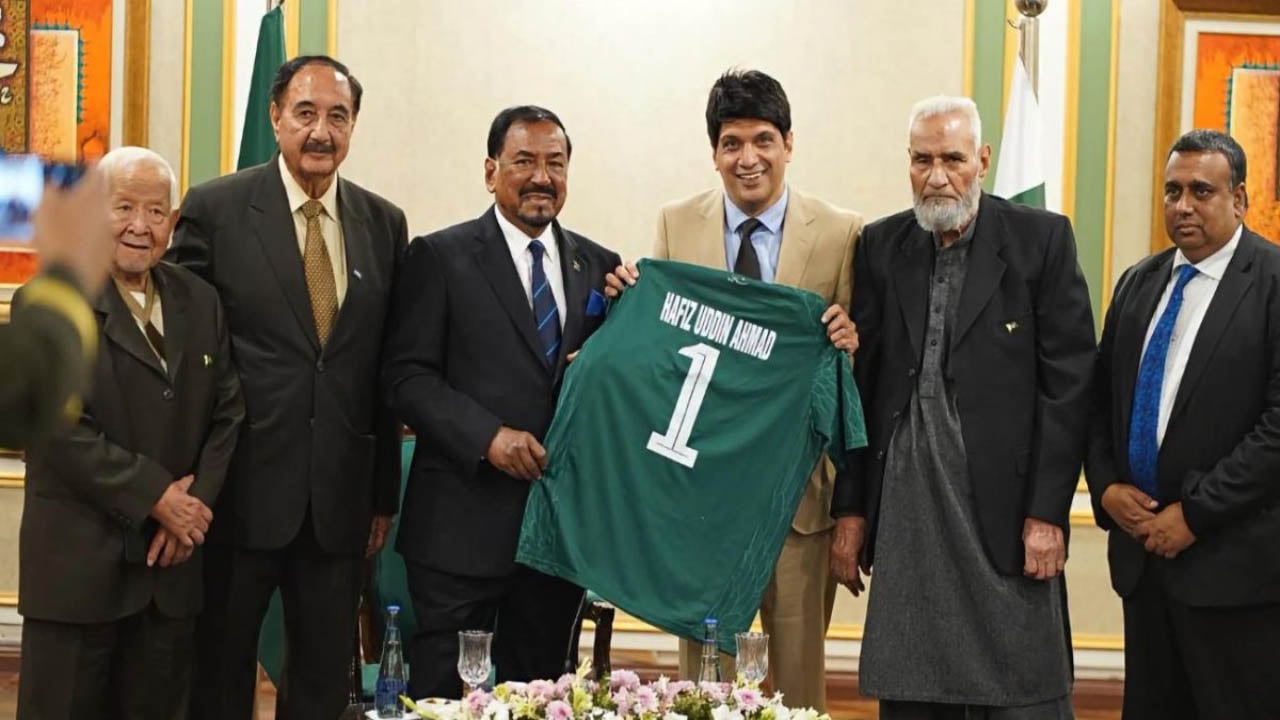

Recently, during a visit to Pakistan, Hafiz Uddin Ahmed was reunited with long-time old teammates. The Pakistan Football Federation gifted him a commemorative national team jersey signed by his former teammates. This event has brought his colorful football career to the fore anew.

He played regularly for the Pakistan national football team from 1967 to 1970 and served as captain in 1968. Among Bengali footballers who regularly got opportunities in the Pakistan national team from then East Pakistan, he was exceptional. Besides participating in multiple tournaments, he also led the team. In the Regional Cooperation for Development (RCD) Cup football competition involving Pakistan, Iran and Turkey, he was captain of the Pakistan team.

The rise of Hafiz Uddin Ahmed as a footballer occurred while studying at Dhaka University. He came into discussion by scoring hat-tricks in two consecutive inter-department football competitions. Then in 1962 he began playing in the Dhaka Football League for the Fire Service team. He played there until 1965. After spending two seasons at Dhaka Wanderers Club, he joined Mohammedan Sporting Club in 1968. Until retiring from football in 1978, he played only in the black-and-white jersey.
As a forward, his greatest strength was speed and the ability to penetrate the opponent's defense. In a report published in Pakistan Observer on 27 June 1970, he was described as one of the country's sharpest and fastest wingers. It also mentioned his ability to beat one or two opposing players with the ball at his feet, move forward quickly, and score with powerful shots.

Playing for Mohammedan, Hafiz Uddin achieved multiple successes. The team won Dhaka League titles in 1969, 1975, 1976 and 1978. In 1968 they won the Aga Khan Gold Cup. In 1976 he also captained Mohammedan. He also played an important role in the Abahani-Mohammedan rivalry. In Dhaka derbies against Abahani, he scored seven goals in 10 matches.

One of the most memorable events of Hafiz Uddin Ahmed's football career was scoring six goals in a match in the Dhaka League. Playing for Mohammedan against Fire Service, he scored six consecutive goals. In Bangladesh football history, this is mentioned as the first double hat-trick in the Dhaka League.
Before that match began, several Fire Service players had requested him not to score too many goals. But after entering the field, he first scored two goals, then completed a hat-trick. Although an opposing player requested him not to score more, Hafiz Uddin ultimately completed six goals. This feat made him one of the talked-about players of Dhaka football.
Known for his speed on the football field, Hafiz Uddin Ahmed was equally talented in athletics. Seeing his running speed, friends advised him to take part in sprints. Participating in the 1964 East Pakistan Provincial Athletics Competition, he surprised everyone by winning the 200-meter race title. From 1964 to 1966, Hafiz Uddin was a member of the East Pakistan Athletics team. In 1965 he became provincial champion in the 100-meter race. The following year he equaled the East Pakistan record in 200 meters. He had the achievement of being the fastest human of All-Pakistan three times in a row.
After Bangladesh's independence in 1971, Hafiz Uddin Ahmed remained involved with football. However, he did not play for the national football team of independent Bangladesh. When Bangladesh's first national team was formed for the Merdeka Tournament held in Malaysia in 1973, he was not included. At the time of the team announcement, Hafiz Uddin had scored seven goals in two Dhaka League matches. Even so, he was disappointed at not getting a place in the national team. Later, in interviews, he alleged political influence behind his exclusion. After Bangladesh's independence, he did not get another opportunity to play for the national team. In 1978, he retired from football after playing his last match for Mohammedan.
Though his playing career ended, Hafiz Uddin Ahmed did not sever ties with football. Later he served as general secretary and president of the Bangladesh Football Federation. He also worked as elected vice president of the Asian Football Confederation and member of the FIFA Appeal and Disciplinary Committee. In 2004 he received the FIFA Order of Merit, recognition of his contribution to world football. He is the only footballer from Bangladesh to receive this honor.
Recently, leading a Bangladesh parliamentary delegation on a visit to Pakistan, Speaker Hafiz Uddin Ahmed returned again to memories of his football life. He met several of those he played with for the Pakistan national team from 1967 to 1970 after a long time. At an event of the Pakistan Football Federation, he was reunited with former teammates. At that time, Pakistan Football Federation President Syed Mohsin Gilani gifted him a commemorative national team jersey. The jersey bore signatures of his former teammates. Receiving that jersey signed by those with whom he once took the field for the same team, Bangladesh's current Speaker witnessed an emotional moment. This reunion seems a reflection that his old identity is still memorable in Pakistan's football arena as well.
From football field to army, liberation war, politics, and finally the Speaker's seat of the National Parliament — Hafiz Uddin Ahmed's life journey is full of various diversities. The field where he once led as captain of the Pakistan national football team, in independent Bangladesh's history he again became known as a valiant freedom fighter and a person holding important state responsibilities. This chapter of his football life is therefore not just a story of personal achievement, but also a memorable part of the subcontinent's football history.