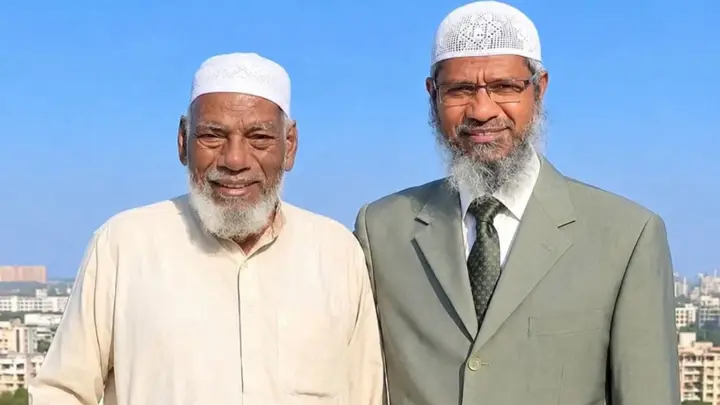

Zakir Naik, an Islamic speaker known worldwide, has gained international recognition by discussing Islam and comparative religion; South African Islamic thinker Ahmed Deedat changed the course of his life. However, in the early days of his da'wah life, his father Dr. Abdul Karim Naik's contribution was important. Abdul Karim, born in 1928 in Ratnagiri, Maharashtra, lost his father in childhood but continued his studies amid adversity; after completing his MBBS from Grant Medical College in Mumbai in 1956, he pursued postgraduate education in psychiatry.

He was also active in education and social development. In 1962, he founded the ‘Nakhshe Konkan Publication Trust’ and began publishing a monthly magazine named ‘Nakhshe Konkan’, which became an important platform for the education and culture of the Urdu-speaking Muslim community and for writers and poets of the Konkan-Mumbai region. In 1994-95, he served as president of the Bombay Psychiatric Society; in addition, he held important responsibilities in various institutions, including as chairman of the Indian Council of Mental Health. For his contributions to medicine and human welfare, he received various national and international honors in 1998-99, including ‘International Man of the Year’ from the Cambridge-based International Biographical Centre.

Zakir Abdul Karim Naik was born on 18 October 1965 in Mumbai. The physician family expected that he would become a great doctor; his mother, Roshan Naik, wanted her son to become a cardiologist and achieve success like Christian Barnard. However, after meeting Ahmed Deedat in 1987, his thinking changed. According to Zakir Naik, he asked his mother — could he be like Deedat, or like Christian Barnard? In reply, his mother said he could be like both; that support from his mother played an important role in determining his life's goal.
In 1991, Zakir Naik founded the Islamic Research Foundation (IRF) in Mumbai. Although he initially carried out da'wah work alongside medicine, his involvement gradually increased, and at one stage he decided to leave the medical profession and devote himself fully to da'wah. His father's support for this decision was extremely important — even though his parents wanted to see him as a neurosurgeon, when their son chose religious work, his father wanted to shape him as a ‘scientific maulana’. Not only encouragement, but for the first few years his parents also bore the expenses of Zakir Naik's da'wah activities.

After beginning da'wah inspired by Ahmed Deedat, Zakir Naik gained recognition in a short time; in 1994, Deedat described him as ‘Deedat Plus’. After the Islamic Research Foundation, with the establishment of Peace TV, his speeches continued to reach various countries of the world; in 2015, he received Saudi Arabia's King Faisal International Award for his contribution to the propagation of Islam.

After a long working life, Dr. Abdul Karim Naik breathed his last on 30 October 2016 at the age of 87 in Mumbai, after suffering a heart attack. At the time of his death, Zakir Naik was not in India, so he could not attend his father's funeral and burial. Although he had envisioned a specific professional future for his child, standing by him when his son chose a different goal remains the most discussed chapter of Dr. Abdul Karim Naik's life.