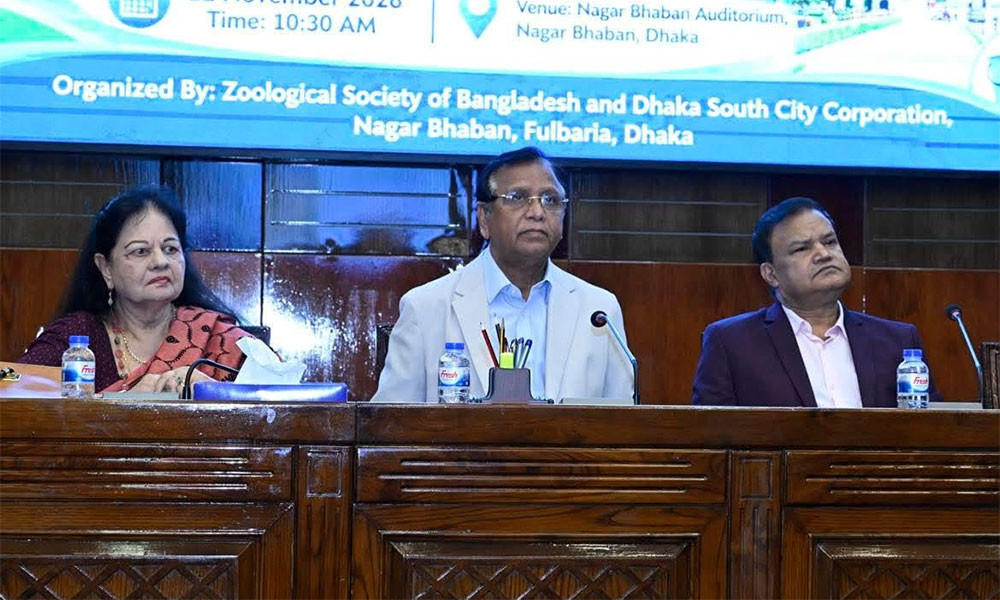

He said these while speaking as chief guest at a scientific seminar jointly organized by DSCC and the Zoological Society of Bangladesh at the Nagar Bhaban auditorium in the capital on Thursday (November 12). The seminar titled ‘Current trends of dengue in Bangladesh: Innovative mosquito control to tackle prevention and public health challenges’ discussed the recent dengue situation, prevention, and science-based mosquito control strategies.

At the seminar, Abdus Salam said that since taking charge, special crash programs have been conducted alongside regular activities to control dengue. A comparative picture of surveys conducted last March and October showed that due to the special activities, the situation in several previously risky wards has improved. However, a matter of concern is that Aedes mosquito larvae were found in nearly 50 percent of the places inspected in the survey, around residential homes.

He said the city corporation is carrying out various activities to prevent dengue, including loudspeaker announcements, leaflet distribution, and awareness campaigns in mosques. However, alongside these initiatives, citizens must also become aware. Rooftops, courtyards, under-construction buildings, and places where water accumulates in air-conditioning units must be cleaned regularly; water must not be allowed to accumulate anywhere.
The DSCC administrator emphasized integrated efforts by the government, city corporation, social organizations, and citizens to build Dhaka city as a clean, green, and livable city. He called on various social and professional organizations, including the Zoological Society of Bangladesh, to become more active in public awareness activities. He also assured that the city corporation would cooperate in such initiatives.

Speakers at the seminar said that only applying medicine or mosquito-control activities is not enough to prevent dengue; emphasis must be placed on destroying mosquito breeding sites and raising public awareness. To this end, they called for cleaning one's own homes, courtyards, and surrounding environment every Saturday. The speakers advised everyone to remain alert so that water does not accumulate anywhere and create mosquito breeding sites.

At the seminar, scientific presentations on the mosquito life cycle and mosquito control were made by Professor Dr. Kabirul Bashar of the Department of Zoology at Jahangirnagar University, Senior Scientist Dr. Shafiul Alam of icddr,b, and Senior Entomologist Md. Rezaul Karim Khan of the Disease Control Branch (CDC) of the Directorate General of Health Services. The chief executive officer of DSCC, Md. Khaibar Rahman, was the special guest at the event. Professor Dr. Hamida Khanam, president of the Zoological Society of Bangladesh, presided over the event. DSCC Secretary Md. Mashiur Rahman Khan, Chief Waste Management Officer Air Commodore Mahbubur Rahman Talukder, Chief Health Officer Dr. Jahane Ferdous Binte Rahman, and representatives from various related organizations were present at the time.