

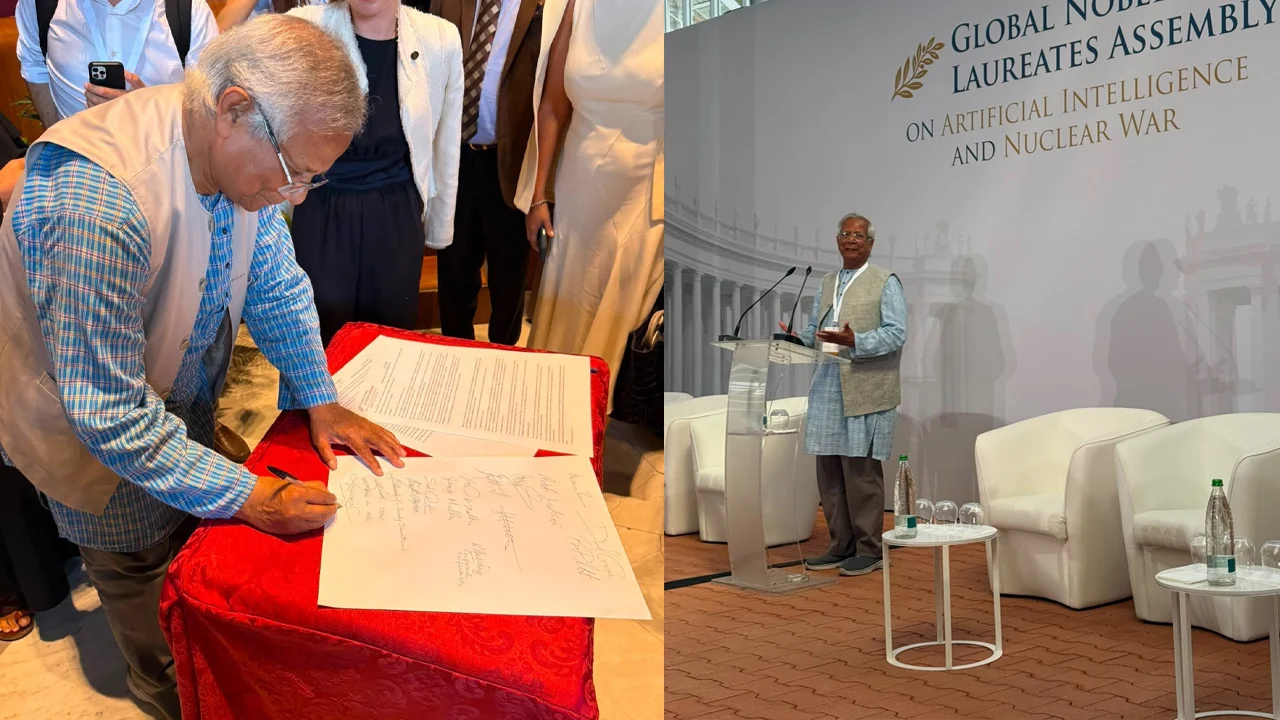

The three-day conference was held on July 16 at the Capitoline Hill in Rome, Italy. The conference concluded with the signing of the declaration titled 'Humanity at the Threshold'.

In addition to Dr. Yunus, the declaration was signed by former Italian Prime Minister Romano Prodi, Nobel Peace Prize laureate Jody Williams, Filipino journalist Maria Ressa, Congolese doctor Denis Mukwege, and former Colombian President Juan Manuel Santos, along with other Nobel laureates from around the world.

The declaration stated that the combination of artificial intelligence and nuclear weapons poses an unprecedented risk to humanity. It warned that an AI-based arms race could make the current nuclear competition even more dangerous, and that global security could face new crises if lessons from the past are not learned.
The Nobel laureates further noted that the use of AI in nuclear command systems could reduce the role of human decision-making. At the same time, there are concerns about increased risks of cyberattacks on critical infrastructure and the erosion of international trust through information warfare.

Professor Dr. Muhammad Yunus delivered a speech at the inaugural session held at Borgo Laudato Si' in Castel Gandolfo, Vatican. Other speakers at the event included Cardinal Fabio Baggio, President of Borgo Laudato Si'; Cardinal Ángel Fernández Artime, Pro-Prefect of the Dicastery for Institutes of Consecrated Life and Societies of Apostolic Life; and Cardinal Silvano Maria Tomasi, President of the Global Nobel Laureates Assembly and President Emeritus of the Domus Communis Foundation.

Also present at the conference were Professor Daniel Holz, Chair of the Science and Security Board of the Bulletin of the Atomic Scientists; Cardinal Peter Turkson, Chancellor of the Pontifical Academies of Sciences; Archbishop Renzo Pegoraro, President of the Pontifical Academy for Life; and Hollywood actress Sharon Stone, along with other distinguished individuals from various countries.
The declaration highlighted six priority recommendations. These include preventing a new arms race centered on AI and nuclear weapons, ensuring transparency and accountability in AI technology development, completely excluding AI from decision-making on nuclear weapon use, establishing an independent international framework under the United Nations for AI oversight, prioritizing youth leadership and education, and calling for a verifiable nuclear-weapon-free world within a specific timeframe.
Nobel laureates believe that to harness the rapid development of artificial intelligence for human welfare, it is essential to ensure effective international regulations, accountability, and global cooperation now.