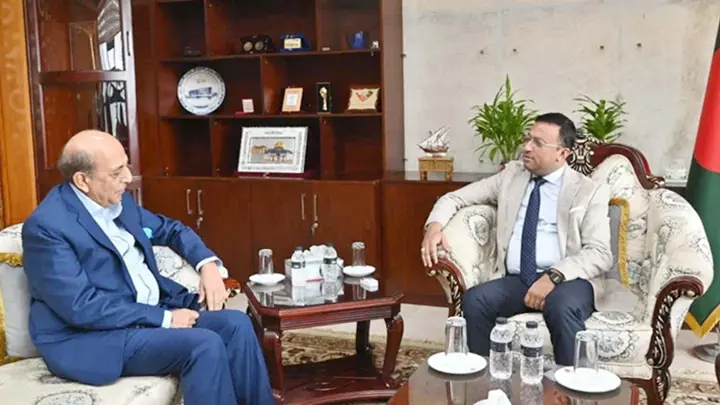




On Wednesday (July 29), a courtesy meeting was held at his office where discussions were conducted regarding the project's financing, construction progress, and future plans.

The Bridge Division stated that the Dhaka Elevated Expressway, being implemented under a Public-Private Partnership (PPP) basis, will play a vital role in reducing traffic congestion in the capital, ensuring uninterrupted communication in the north-south corridor, and accelerating the country's economic activities.

It was informed in the meeting that due to ongoing arbitration proceedings in Singapore over legal complications related to share transfer among shareholders of the investment company First Dhaka Elevated Expressway (FDEE), the disbursement of loan installments from the two Chinese banks financing the project has been suspended for over two years. However, during this time, the investment company has continued construction work with its own financing.
Mohammad Abdur Rouf, Secretary of the Bridge Division, said that since the partial opening of the Dhaka Elevated Expressway, a higher number of vehicles than expected have been using it. He expressed optimism that recovering the investment funds will be easier once the entire project is operational.

He further informed that the Prime Minister regularly uses this expressway and has directed the implementation of a unified Electronic Toll Collection (ETC) system for all toll roads and bridges in the country. The Bridge Division and the Bangladesh Bridge Authority are working swiftly to implement that directive.

Present at the meeting were Altaf Hossain Sheikh, Director (Administration) of the Bangladesh Bridge Authority; Chief Engineer AHMS Akhtar; and members of the Chinese delegation.
Interest in Bhola-Lakshmipur Bridge at Bangladesh-Japan PPP platform
On the same day, at the eighth meeting of the Bangladesh-Japan Joint PPP Platform held at a hotel in the capital, the Secretary of the Bridge Division presented the project for constructing a bridge over the Meghna River between Bhola and Lakshmipur.
The Japanese delegation expressed interest in the project and recognized its strategic importance for regional connectivity, trade expansion, and economic growth in the southern region.
At the meeting, both countries reiterated their commitment to further strengthen mutual cooperation in strategic communication infrastructure development, sustainable economic growth, enhancement of regional connectivity, job creation, and long-term development.